GSS PreBuild

Predictive
Cost Engineering

Automated system for investment risk assessment and construction cost modeling based on Unreal Engine 5.

IN DEVELOPMENT
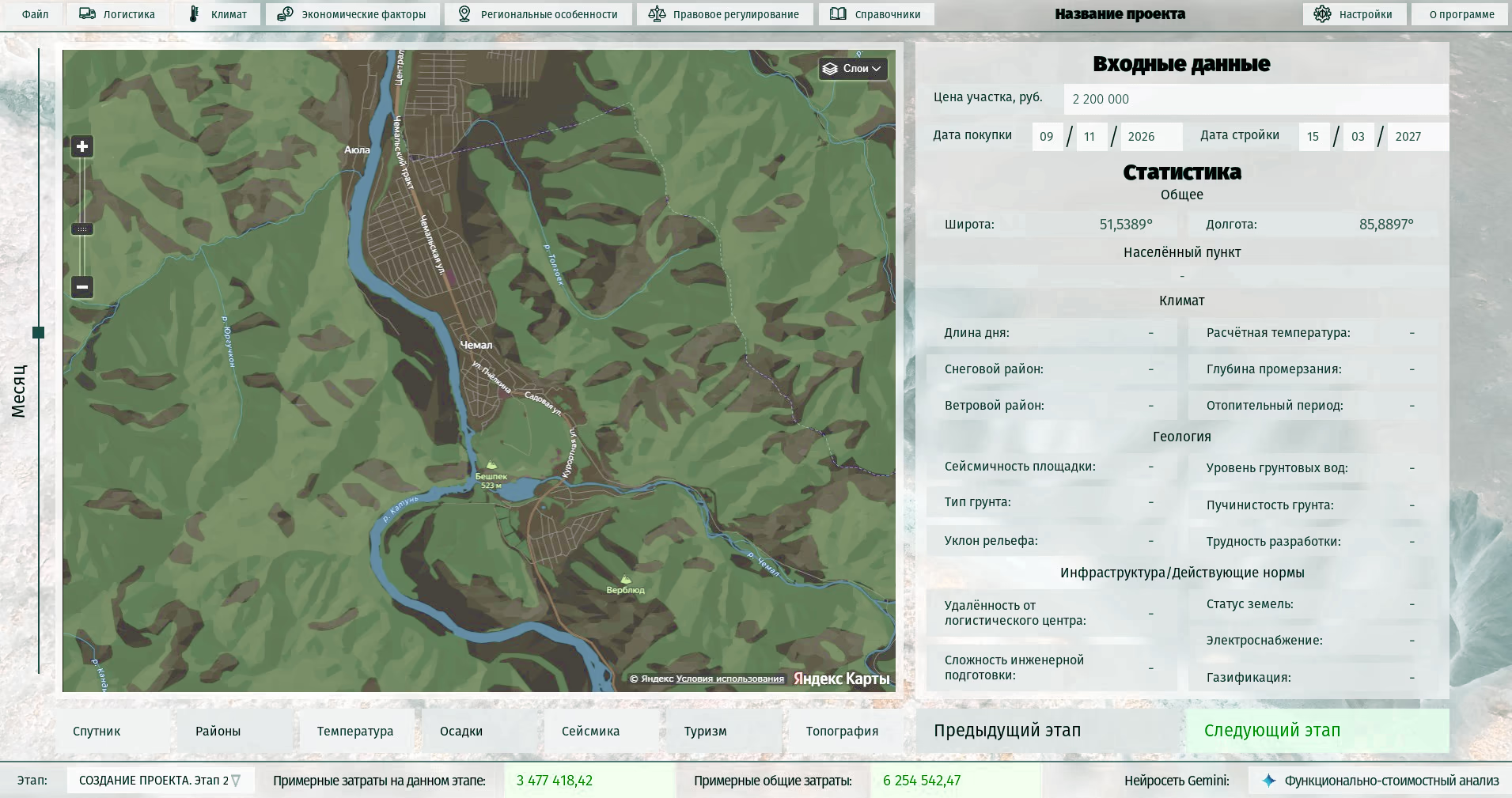
Product Interface

Managing Uncertainty

Select a module on the left to learn how the system handles stochastic pricing factors at the concept stage.

Settings
Legal Info
Dashboard

Process Transparency

The interface is designed for instant validation of design decisions, ranging from parametric soil physics inputs to macroeconomic correction matrices.

From Abstract Ideas to Precise Figures

Assessment of Life Cycle Cost (LCC) and investment attractiveness.

00:00 / 00:00
LEARN MORE

Software Suite

A tool for investors, developers, and lending institutions, reducing investment risks by up to 30% at the concept stage.

Developed in Unreal Engine 5

Powered by SQLite & LLM Semantic Engine

Frequently Asked Questions

What is Life Cycle Cost (LCC) within the software?
The LCC module evaluates not only construction costs (CAPEX) but also future operational expenses (OPEX). It enables investors to perform multi-criteria optimization: comparing one-off expenditures on energy-efficient materials against the discounted cost of future heating losses over a 30-year horizon.
How does the 'Cascade Logistics Model' algorithm work?
The algorithm identifies 'supply chain continuity disruption points' (weight-restricted bridges, steep slopes, narrow roads). When a barrier for heavy trucks is detected, the system switches to a transshipment scenario, calculating the cost of manual labor and shuttle runs of light-duty vehicles, which improves estimate accuracy in remote areas by 25-40%.
Why is Fuzzy Logic used in the software?
To convert qualitative assessments (e.g., 'high tourist traffic' or 'complex legal disputes with neighbors') into mathematical coefficients. The Mamdani algorithm aggregates these inputs, forming a realistic 'Risk Reserve' that saves the project from catastrophic profit margin erosion.
Is the calculation deterministic?
The baseline cost (building envelope) is calculated strictly using a deterministic resource-based method. However, logistics, staffing, and legal markups are stochastic. The program combines both approaches to create a 'Hybrid Cost Engineering Model'.